Monday, January 18, 2010

DANE'S WORLD

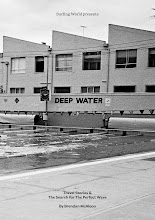
I’ll begin with Stuart Nettle’s review on Swellnet. Without swimming too deep in my own shit, it’s my favourite review of the book to date.

“The narrative often veers away from the main trail while the author pulls a thread of his surfing life through the history of surfing and the world at large. And so, one moment you are reading about travels with Ted Grambeau through the Tuamotos and the next a philosophical explanation why human beings have an inherent need to wander, replete with quotes from Umberto Eco. McAloon connects idea and anecdote seamlessly.”

So I read the review, was pretty buzzed to be mentioned in the same sentence as the late great Grant McLennan (singer-songwriter with The Go-Betweens), and then drifted around the ‘net, as you do when you’re draining a sixer of Crackenback Pale Ale. Eventually I ended up on Dane Reynolds’ blog, Marine Layer (his most recent entry riding Yadin Nicol's 5'4" quad is v.cool but I highly recommend the October 14 entry of Dane riding Rob Machado’s 1997-era fish below... among others).

Dane makes a brief cameo in Deep Water, bobbing up in Madrid of all places. I did a few trips with him when he was but a talented and uncertain teenager, a few years before he was anointed as the next American surfing hero. I chaperoned him to the Canary Islands when he was 16 years old and sponsored by Rip Curl. It was one of my favourite surf trips, but I don’t think it was one of Dane’s. The kid was green and the European contingent attempted to force-feed him the local “culture” when all Dane wanted was an In-N-Out Burger. But man, could he surf. Dane was a late replacement for Pancho Sullivan and, despite a fairly respectable line-up of Rip Curl’s finest, the relatively unknown teenager from Ventura stole the show. One morning we scored the islands’ premier wave, a gnarly reef break that does a pretty reasonable impersonation of Pipeline (its name is roughly translated as “the beast”) and detonates on an urchin-infested slab of volcanic rock. It was howling offshore, low tide and uncrowded; considered too sketchy a proposition even by the heavy local bodyboard crew. But Manoa Drollet barely batted an eyelid and, in his typical laidback Tahitian style, sauntered into the take-off zone with Dane and Darren O’Rafferty in his wake. Now the man dubbed the Prince of Teahupo’o had his backside tube-riding down to a fine art – grabbing rail on take-off, side slipping down the face before letting go of the rail at the base of the wave, then casually stretching out inside the tube. It was a hyper-critical approach honed through years of surfing Teahupo’o that Manoa made look all too easy.

But the beast was hungry... After a tentative opening, Manoa came unstuck on his second wave and got throttled. Raff and Dane, both yet to catch a wave, watched on in a mixture of horror and disbelief. It was a pretty heavy situation and 16-year-old Dane could have easily been forgiven for taking a backward step. While Manoa barely missed a beat – the Tahitian swapped boards and was soon back in the fray, flying out of a series of incredible caverns – it was the kid who proved the surprise packet. While even now his heavy water credentials are sometimes called into question (I’d suggest they’re simply overshadowed by his fun approach to surfing and ridiculous above the lip act), he was soon mimicking the Tahitian’s hands-free style, albeit a little less casual than the master. The steep learning curve was remarkable to watch.

Over the next few years Dane’s raw talent reached a wider audience. And, while torn between competition and chasing a Dan Malloy-inspired free-spirited surfing existence, he became the focus of a bidding war that saw him part ways with Rip Curl. He initially embarked upon the free-surfing route with new sponsor Quiksilver and produced a mind-blowing movie, First Chapter (the surfing was mind-blowing, the movie itself was pure surf porn), before eventually landing on surfing’s elite tour a much more complete surfer. I talked to him about it when he made his debut on the Gold Coast in 2008.

“I try not to think of surfing as a career-wise,” Dane explained. “To make decisions with a career in my mind, it just loses the fun of surfing. I hate thinking of it like a job. If I get tired of competing, I’ll quit doing it. When I was a kid I remember I did an interview with Rip Curl, I was like ‘I want to be world champion’, because that was burned into my brain, that was what you say. But I don’t really care. I’m not willing to sacrifice as much as you have to sacrifice in order to win a world title. You look at Mick (Fanning) and he dedicates his whole life to competing and winning, and that’s great, he obviously gets a lot of satisfaction out of it. I don’t think I get enough out of it to really give up a lot of the things that I do… well… I’m not ready to not go drink beers before my heats and stuff. My whole goal is to not compromise my surfing for the competitive format; surf heats as if it wasn’t there... I just kind of question my competitiveness when I see people bank their whole emotional state on how they’re going to do in each heat, and I don’t feel that. For me I’m kind of in a fortunate position; to go out there and not care if I win or lose, and really surf the way I want to surf.”

Few would question whether Dane has achieved this – the kid is an excitement machine. But in his second year on tour he’s also achieved a few other things; his quarter-final at Jeffreys Bay was arguably the performance high point of the year, while making the final at Trestles and the semi-finals at Pipeline secured his first top 10 finish. And while there is no doubt that Parko would be a popular and well-deserving world champion in 2010, in my humble opinion, so too would Dane Reynolds.

Wednesday, December 16, 2009

WALKING TO THE SHOP FOR BREAD


In a recent interview to accompany an exhibition of his work in Portugal, surf photographer/extraordinaire Jon Frank said he found inspiration in the “everyday existence”, including “walking to the shop for bread”. I have known Frank for over a decade yet have never known him to ever walk to the shop for bread. “Anyone who knows me can attest that this is bullshit,” he later confessed. “But I would counter their barbs by saying that sometimes I ride my bike.” Acclaimed American surf photographer Jeff Divine once said, “surf photography is starvation on the road to madness”. In Matt Warshaw’s magnificent book Photo/Stoner, which recounts the strange story of legendary 1960’s surf photographer Ron Stoner, Divine explains that it is widely understood within the industry that “surf photographers are all a bit… tweaked”. While Stoner was famously the first of this eccentric breed to officially lose the plot (he went into electro-shock therapy in 1968, was listed as a missing person in 1977, and declared dead in 1994), he certainly won’t be the last. Behind the glamorous façade of travelling the globe capturing beautiful images of the ocean lies a myriad of obstacles and challenges. “Look closely at what it takes to be a successful surf photographer and you’ll be more sympathetic,” Divine implores.

Jon Frank would be considered a successful surf photographer. For the past two decades he’s made a living from expressing his unique vision of surfing and ocean waves, which is quite a feat in itself. He filmed the seminal surf film Litmus in 1995, and a slew of award-winning surf films followed, including Super Computer in 2001, Mick Fanning’s acclaimed biopic Mick, Myself & Eugene, and more recently Musica Surfica. But the still image is Frank’s preferred medium and where he is held in highest regard; he won Photo of the Year at the 2007 Surfer Poll and Video Awards and the 2008 Australian Surfing Awards, and is widely regarded as the artist of the surf image. “What Jon Frank does is ART,” according to grizzled Hawaiian surf photographer Sean Davey.

Despite Divine’s assessment, I am not implying that Jon Frank is “tweaked”. In fact, Frank is one of my closest friends and I admire him far beyond his ability to capture ethereal ocean images. But, as Derek Hynd explained in the introduction to Frank’s 1999 book Waves Of The Sea: “He is not normal. His work is not normal.” A perfect example is his ongoing Frankology series for Surfing World magazine, which is without peer and demonstrates his virtuosity – most are shot over a few days and are brilliant snapshots of people and places, accompanied by Frank’s vivid musings about everything from memories of his much-loved father to riding the tattered sea, “daydreams and life plans hatched under the murky light thrown by a single round porthole”. It doesn’t always make sense and sometimes feels like an unedited invasion into his inner most thoughts, but it is Frank, and brilliant nonetheless.

Frank joined me on many of my expeditions for Deep Water, initially as a hired gun for Rip Curl, and later when his path crossed with the pro surfing circus and he needed a couch to crash on or a hotel room to shower and shave. He appears intermittently throughout the book, and his incredible images of Hawaii’s outer reefs and Icelandic beaches gave the book an esoteric layer that lifted it beyond my imagination. Frank also provided comic relief:

“The boat was island-hopping from Biak to West Papua, searching unsuccessfully for surf. We drifted in the lee of an uncharted bay, a large sea eagle circling overhead. I lay on the top bunk reading, peering out the dirty porthole to check the waves. Again. Waist-high chunks of windswell sloped onto an exposed limestone reef. The jungle swayed. A dead tree stood proudly on the edge of a slender strip of sand. My head went back to the pillow, fumbling to find my page, tempted by my hidden stash of Beng Beng chocolate bars. Frank woke up. He declared: “I’m going on the ‘net when I go home. I’m going on the ‘net to meet a woman”. He slammed the door and stamped down the passage, his footsteps echoing around the wooden hull. I heard the lock on the toilet click.” – Chapter 7, The Curse of the Indo Jiwa

But Frank is more than comic relief. He's more like something closer to Kerouac’s Dean Moriaty in On The Road, albeit without the wild exuberance and swashbuckling good looks. And, despite recent forays into the fine art world, documenting classical musical festivals in Slovenia, Frank is still on the road. Right now he is in Hawaii. He sent me an email a few days ago. I could instantly picture him, in his small room tucked in behind the garage of a sprawling Ke Nui Road mansion, bent over the keyboard, Sufjan Stevens crooning in the background, wet footprints and sand at his feet. Right outside the door is his office – the stretch of sand between Log Cabins and Pipeline, where the world’s best surfers spend each December performing on cue for the cameras. Frank will be among them, rubbing shoulders with Davey, Grambeau, Buckley & co. It sounds glamorous. It isn’t. “It’s hard to be 38 years old, having been a professional surf photographer for 15 years, looking down the barrel of 40, wondering whether I can keep doing it,” Frank told me recently. He doesn’t want to sound bitter. He isn’t. “I’m not saying it’s not a great job. I’m used to the insecurity. I’m pretty used to not having any money. The travel becomes more difficult when you have a family but I understand that people would dream of doing it instead of working in an office or a factory.”

I know exactly what he means. I’m back in an office, grinding out the 9 to 5. And while there are elements I really enjoy, I have my moments, dreaming of that boat drifting in the lee of an uncharted bay somewhere east of Sulawesi. I’m no longer Sal Paradise to Frank’s Dean Moriaty. I’m busy conjuring up domestic bliss on a curve of the Great Ocean Road, staring at a sink full of baby bowls and brightly coloured utensils. As Frank once wrote: “Standing, shoulders down, enjoying warm hands, stopping occasionally to watch the moonlit trees bend behind the west wind, all of us together but alone, beneath this vast Bill Henson sky.” Or in my case, an underexposed Jon Frank panorama.

Sunday, October 18, 2009

THE GURU OF ANDERSON STREET

I moved to Torquay at the tail end of 1996. I moved up the coast from Warrnambool, returning to university to complete a journalism degree I’d been studying via correspondence, and moved into a ramshackle old holiday house in Anderson Street. Russell Graham lived across the road. Russell had arrived in Torquay via different circumstances. Back in the late 60’s Russell was at the heart of the Australian surfboard industry, making surfboards for Midget Farrelly in Brookvale on Sydney’s northern beaches. Embracing the counter-culture of the early 70's, he and a mate (Gary McKenzie-Smith) decked out an old school bus as a surfboard factory on wheels, christening it Change Surfboards. They travelled down the coast, stopping in car parks at surf breaks, doing ding repairs and making surfboards. Eventually they arrived in Torquay, where Russell met his wife Barb, and teamed up with Doug ‘Claw’ Warbrick and Brian Singer to make Rip Curl surfboards – Russell glassing shapes from the likes of Wayne Lynch, Pat Morgan, Alan Colk, Doug Rogers, Maurice Cole and, more recently, Michael Anthony.

Russell has spent the best part of 50 years inhaling resin fumes and consequently he’s a bit of an eccentric. I’ve seen photos of him trimming across the face of six-foot waves at Bells Beach bolt upright in the sirsa-ashana pose, more commonly referred to as a headstand. These days he’s taken to wearing a floppy black beret, giving him the appearance of a French intellectual, with his long grey hair tied back in a ponytail and delicately trimmed moustache and goatee.

Over the years Russell’s factory (Moonlight Laminating) has become a popular haunt of mine. When I worked at Rip Curl I’d often sneak across the road for a few moments of sanity and ever since have enjoyed dropping in for a chat, soaking up the atmosphere, the foam dust and fumes. A few years ago Russell helped me shape my first surfboard; a snub-nosed 6’3’’ that wasn’t a complete disaster but not enough of a success for me to ever shape a second. A keen car enthusiast and multiple Victorian Hill Climb champion, he’s slowed down a bit in recent years. He had a quadruple bypass last year and, while he was back in the factory within a few weeks, these days he spends his time on old-school restorations rather than churning out bleached white shortboards (at its peak Moonlight was producing over 1,000 boards a year). His son Corey is back in the factory, shaping and sanding. I interviewed Corey for an upcoming issue of Surfing World magazine. “I count myself lucky,” Corey said. “I don’t think we’ve ever had an argument in here. He’s hassled me to get more work done occasionally but that’s about it.”

Torquay has changed a lot since I moved to town more than a decade ago. The old ramshackle rental in Anderson Street has long gone, replaced by cardboard cut-out townhouses. The uni students have gone too – holiday rentals a thing of the past. But it’s still a surf town. And there are still people like Russell Graham.

Tuesday, September 8, 2009

COASTALWATCH FEATURE

Australia's premier surfing website, Coastalwatch, recently ran an extract from Chapter 9 of Deep Water (Whitecaps & Windsocks) as a travel feature. The extract charts an excursion to Iceland, driven by that obsessive wave-hunter, legendary surf photographer Ted Grambeau. Ted passed through his old home state of Victoria a few weeks back, catching the biggest swell in recent memory and witnessing his Old Navy Blues cop a good old-fashioned shellacking at the hands of Adelaide in the final round of the AFL home-and-away season (Ted was a teenage football star for the Wonthaggi Blues before a knee injury ended his career). Ted and I passed like ships in the night. On Thursday, August 27, while he disappeared down the coast with Maurice Cole, Tony Ray, Ross Clarke-Jones & co, I managed to snag a couple of bombs at Bells Beach. It was big and cold and grey, and I was under-gunned and outclassed by a man with no fins (Derek Hynd) and another riding a surfboard his Dad shaped back in the 70s (Kye Fitzgerald on the same board that Hawaii's Bobby Owens rode at Bells Beach in 1981).
And then winter ended.

Saturday, August 29, 2009

AIREYS FESTIVAL OF WORDS

The hardest working man at Hip & Shoulder Books has put together a short clip from the Aireys Festival of Words and uploaded it to You Tube.

Friday, August 21, 2009

ME AND MINE ONLINE

I’ve stepped beyond my blog and made Billy Bragg’s great leap forwards, across cyberspace, and… onto other people’s blogs!

Well, that’s not completely correct. Three Thousand isn’t a blog. It’s a weekly online guide to all things good in Melbourne, like film, music, design, books and art. Deep Water was the featured “read” in issue #218 and Max Olijnyk’s review was one of the best yet, describing Deep Water as “good with a whisky in the bath”:

“In anything worth doing, there are the godlike people who were simply born to do it. These are the poster boys, the winners, the ones girls have a crush on. Bless 'em. Then there are dudes like Brendan McAloon…”

The Three Thousand review also coincided with an appearance at the Aireys Festival of Words alongside fellow travel writer Patrick O’Neil, author of Sideways: Travels with Kafka, Hunter S & Kerouac. There was quite a crowd and it all went relatively smoothly… Patrick and I waxed lyrical on travel, read some passages from our respective publications, answered a couple of curly questions from the assembled throng, and signed some books. While I didn’t exactly shine in the spotlight, I didn’t completely butcher my first real foray into public speaking. So I was surprised when I bobbed up on Lady Chameleon’s fashion blog, and she said she was “impressed”, describing yours truly as “barefoot, weathered, determined and intelligent”, which caused my wife much mirth. “You weren’t barefoot,” she guffawed. “It was cold and raining.” I tried to explain that I had been barefoot at various stages during the day, somewhere between bed and the bathroom, and for a few miserable hours groveling in the shorebreak at Fairhaven…. Yes, I’d definitely been barefoot. However I thought I looked more disheveled than weathered, while the jury remains out on determined and intelligent.

But back to Lady C, who found Deep Water “fantastic” and “exciting”:

“In true surfer style it relaxingly introduces you to surfing, leads you through its history and takes you out the back... The perfect gift to inspire your man to follow his dreams.”

Thanks to Mr Olijynk and Lady C, and stay tuned for a web clip from the Aireys Festival of Words (and many thanks to the organisers of said festival, particularly Nicole and Marty Maher).

Monday, August 10, 2009

WHO LISTENS TO THE RADIO?

...that's what Jon von Goes wants to know.

Over the past six months I have been spending some time with local surfboard shaper Maurice Cole, whittling away at an in-depth feature article for Surfing World magazine. Maurice is one of Australian surfing's great characters. While I don't want to give too much away (you'll have to wait for the finished product), he has an amazing life story and has added a few colourful chapters in the past 12 months, including a "miracle" recovery from prostate cancer. We were talking yesterday about his website. Fresh from California, Maurice had posted an interview he did in the States with Down The Line digital radio. So I thought it high time I uploaded some audio of my own (the earth moves slowly but the ox is patient).

Over the past few weeks Deep Water has hit the radio airwaves. Firstly via a glowing review on ABC Radio by award-winning Melbourne writer Paddy O'Reilly:
Really well written…an enjoyable read. I don’t know anything about surf, I’m not particularly interested in surf, I’ve never stood up on a surfboard but I was still fascinated by this journey that he takes. He’s a natural writer and he does weave into every chapter some history, either of surfing or of the place that he has gone to."
Listen to the full review here.

Then last Sunday afternoon I made a guest appearance on Melbourne independent radio station Triple R, joining Jon von Goes (pictured above) on his popular JVG Radio Method show. As fate would have it, my appearance coincided with an incredible day of waves on the Surf Coast. While I was reading extracts from Deep Water amid JVG's fine selection of surf music, my old mate Mick Ray was firmly slotted at Winki Pop.